

Brief note up top: this is a post where I introduce a post-platform music library & distribution project I have been working on for a couple years. It begins a bit abstractly before becoming more concrete. If your eyes begin to glaze over, there is a link to a demo video at the bottom of this post, but it might make more sense if you read the text in full.
Let’s begin with the question where does music exist on the internet?
You might be tempted to respond “it’s everywhere,” or maybe “it doesn’t.” Both true in important senses, but neither is wholly satisfying or substantively useful.
You might say “on Spotify, or Bandcamp, or YouTube, or Discogs, whatever, stop being cute.” To which I would respond, those are four completely different senses of “existence.” I promise I have a point, and an answer, and a pragmatic one at that.
What happens if we mutate the question to how does music exist on the internet?
If music exists by being a file that is streamed to your phone or computer by a rentier corporation, then sure, it exists on Spotify. If music exists as a file that can be purchased directly from a musician or record label, it exists on Bandcamp. It can also exist as a video with a comment section (YouTube), or a waveform with timestamped comments (SoundCloud), or pure metadata (Discogs, MusicBrainz, Rate Your Music).
But let’s say that a new musical work was just released, and it rang you like a bell, so perfectly did it resonate with you, and you want to “collect” it into your “library.” Do you click a heart-shaped icon on Spotify? Do you purchase it on Bandcamp? Do you add it to a YouTube playlist, or your Discogs wantlist, etc.?
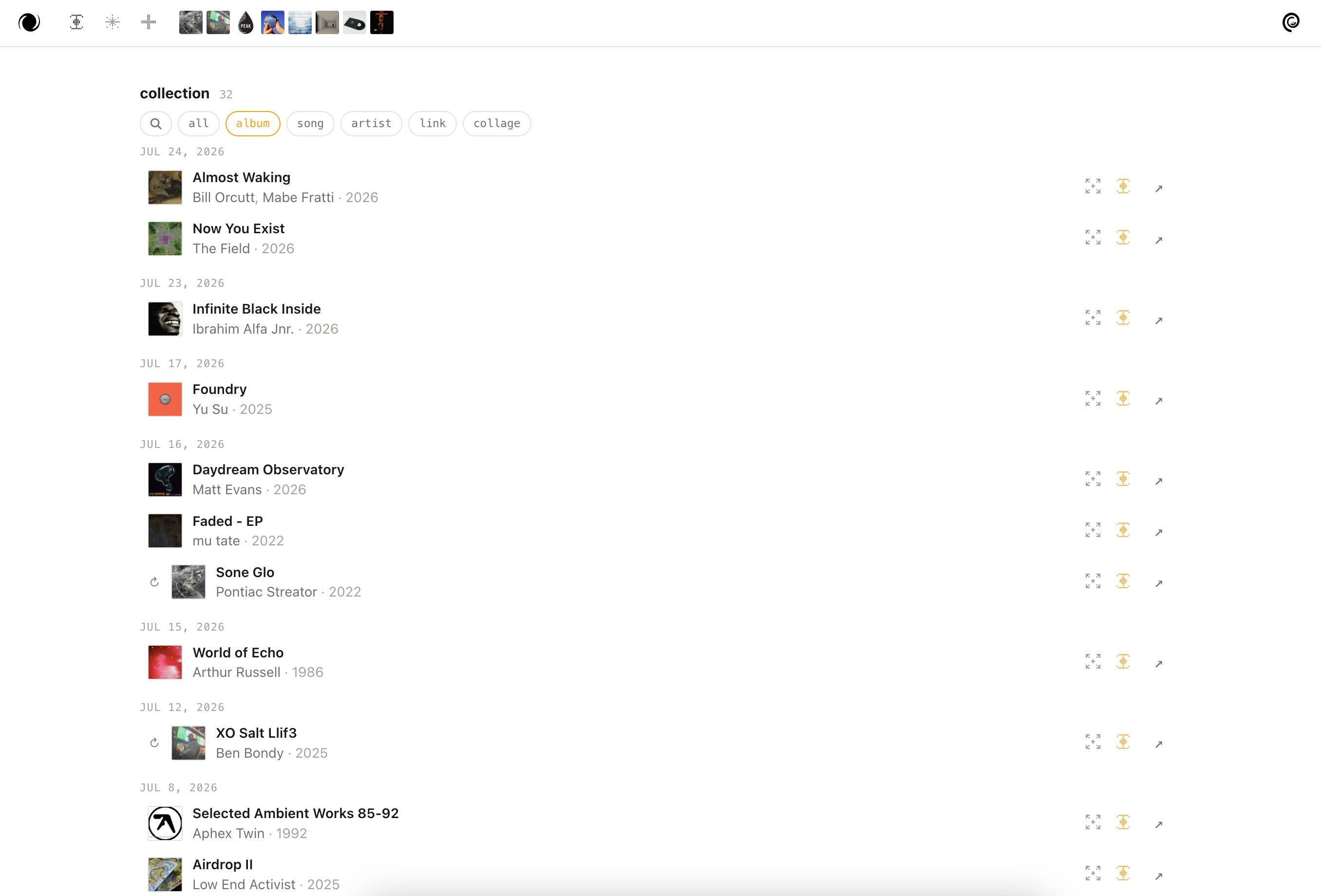
How do you share it with a dear friend? Where do they think music exists? If you send them a Spotify link, you deliver them to a rentier corporation. If the release is on Bandcamp, cool, that feels kind of ethical and less enshittified. A YouTube link might inadvertently become a domino that collapses your friend’s next few hours.
My contention is that these questions of where and how music exists on the internet are of practical importance. The digital ontology of music is formed by consensus, and it is difficult to overstate how much is at stake in where its contours are drawn. When Radiohead released In Rainbows as a pay-what-you-want album directly to fans in 2007, it re-drew those contours. I was 17 years old, and I stayed up til midnight on release day to see if I could in fact pay $0 for an album by the biggest band in the world. Less than a year later, Bandcamp was founded.
There are other punctuating events. Napster, iTunes, torrents, Spotify. Each of these shifted the ontological territory, new hows giving birth to new wheres.
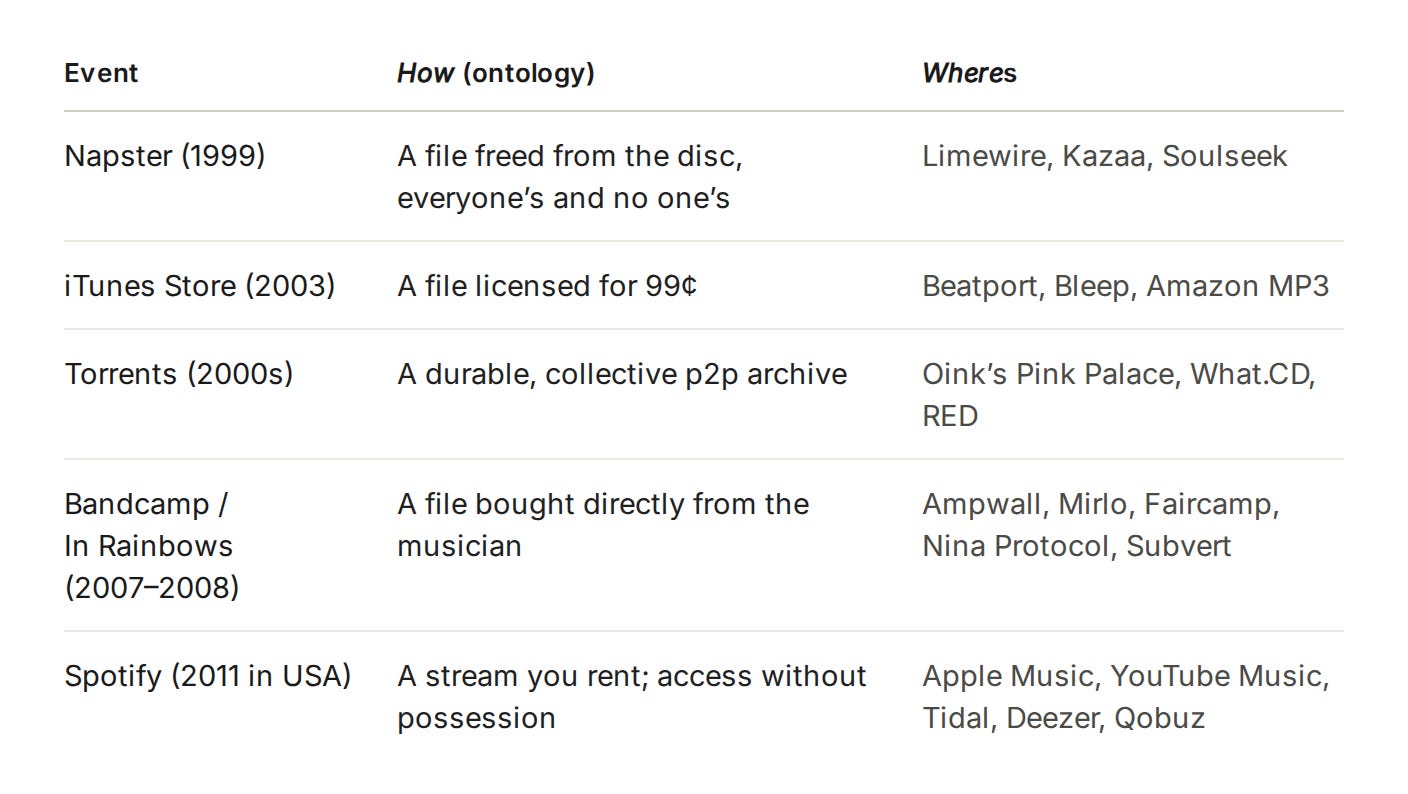
Two conclusions naturally fall out of this table. One, that’s a vertigo-inducing number of shifts in the space of roughly a decade. Two, it’s been more than 15 years since anything has really changed. Is the corporate rentier model the final word on the existence of music online? Is this the end of history for digital music?
What follows is going to sound like a product pitch. From certain angles, ctx is a product, but it more aspires to the status of a public good, or an institution, or part of a larger collective protocol. Maybe that sounds grandiose, but all of this is to say that I am not trying to make a bag by selling a startup. In investor speak, there is no “exit” on the roadmap, because there are no investors. In fact, I am doing everything I can to make it constitutionally impossible for an “exit” to happen, thinking through collective governance strategies, succession plans, remunerative shared maintenance burdens, persistence and redundancy, the list goes on.
Of course, none of that matters if nobody cares about ctx.
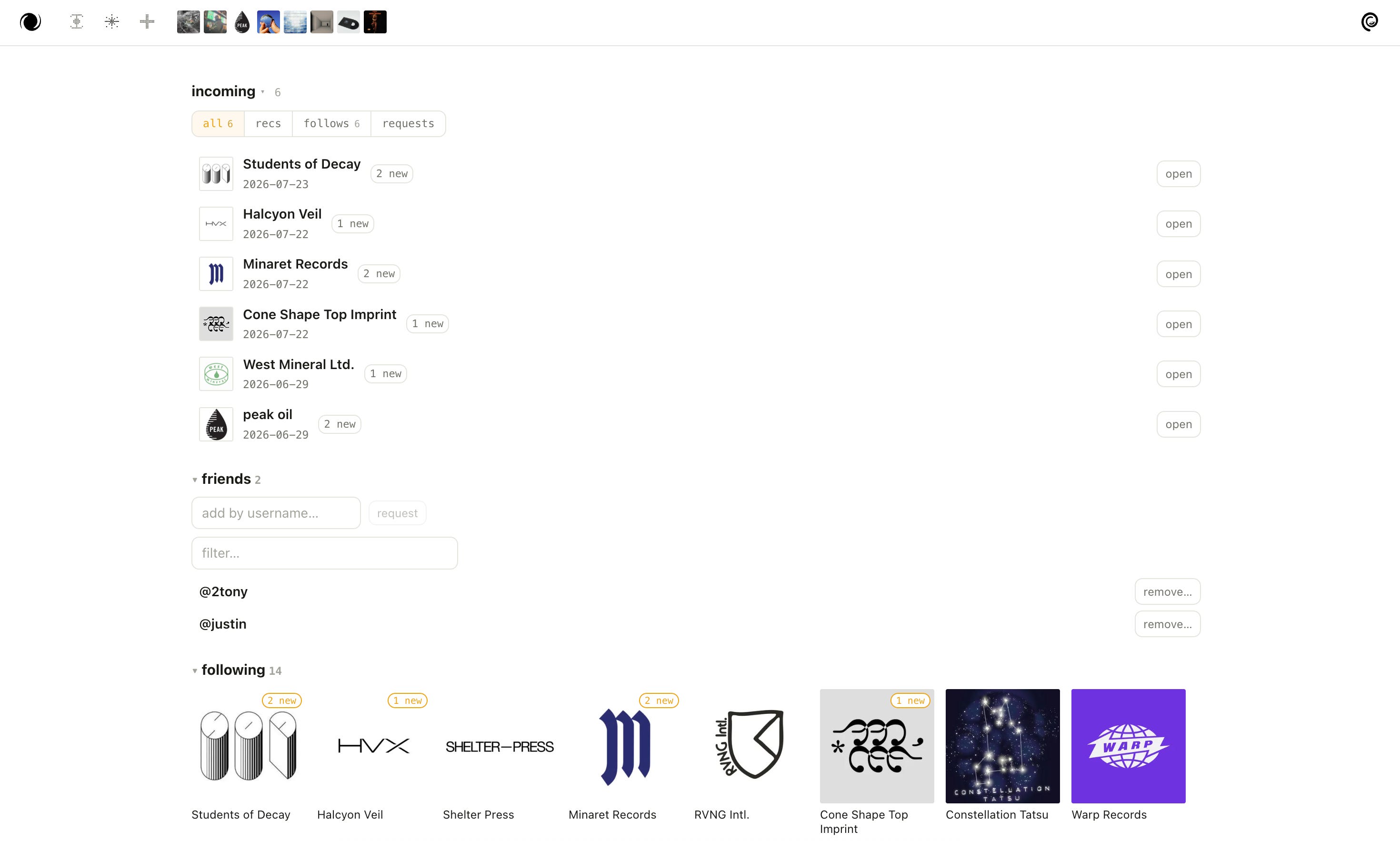
What is ctx?
ctx (“context” when you say it out loud) is a place where your music library, and aspirationally, music generally, can exist1 outside of the boundaries of any particular platform. How is that possible without creating another platform and replacing like with like?
Imagine all of the platforms that exist, and place them into an arena. There they are, engaged in a life-or-death struggle for market share. Some are more virtuous, others cleave to the sole principle of maximizing shareholder value. No matter. We aren’t stepping into the arena.
Instead, we are creating a set of objects representing the digital existence of the musical works we love. These exist outside of the arena, on a different plane, but they point to the instances (hosted files, basically) of these musical works within the various platforms. So we have this object-instance schema – a bit Platonic, but usefully so for our purposes.
ctx is not engaged in music distribution, but in cataloging all of the distributed instances of musical works, across all services, and consolidating them into durable objects. These objects themselves exist in a place that is insulated from darwinian market logic, because ctx is a collectively maintained public good, like most of the internet’s infrastructure2.
What are the benefits of this collective approach, versus the corporate one?
Legitimacy
No existing platform can make a real claim to legitimacy, to being the object rather than the instance. Legitimacy is, definitionally, collectively determined. A profit-seeking company cannot qualify as a claimant to legitimacy, because structurally it is the company’s responsibility to prioritize profit, creating an ever-present risk of compromise and extraction. A cultural repository must exist as a public good.
Persistence
Companies are born and die with the tides of the market. Their existence is too contingent to underwrite durability on the order of decades or centuries.
With sufficient legitimacy, a public organization can become an authoritative place to catalog and encounter cultural objects. What’s more, these objects can be related to one another in ways that honor the rich web of context within which they exist.
Interoperability
Platforms exercise varying levels of control over their data, for good and bad reasons. The express purpose of a public repository is to be maximally accessible, to be a non-prescriptive substrate upon which any number of useful systems may be built. For example, imagine that your personal music library, or music generally, could be rendered not just as rows in a table, but as a garden, or a three-dimensional galaxy conveying to the relation of one work to another. It’s the same data, but suddenly there is an infinite number of ways to interact with it.
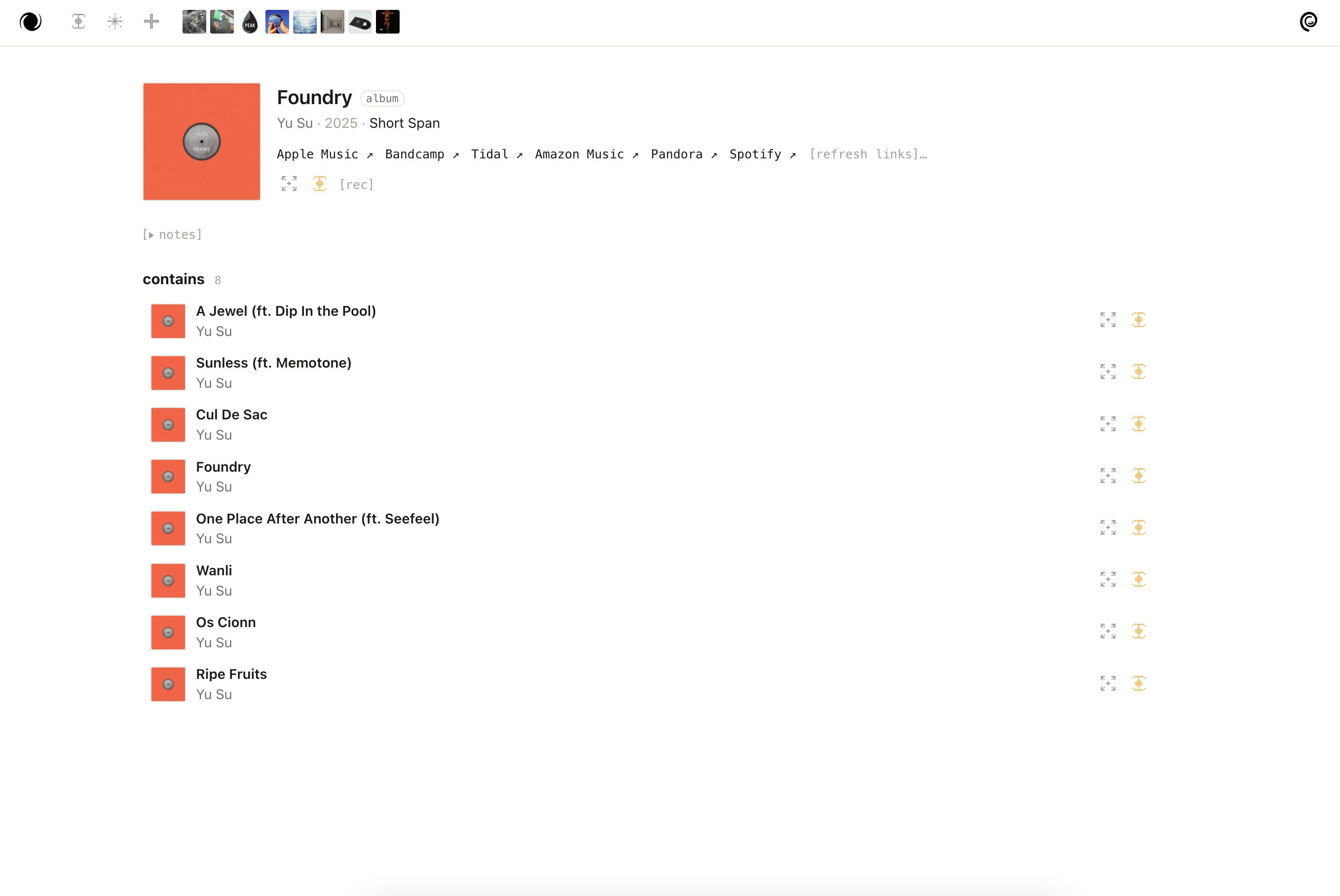
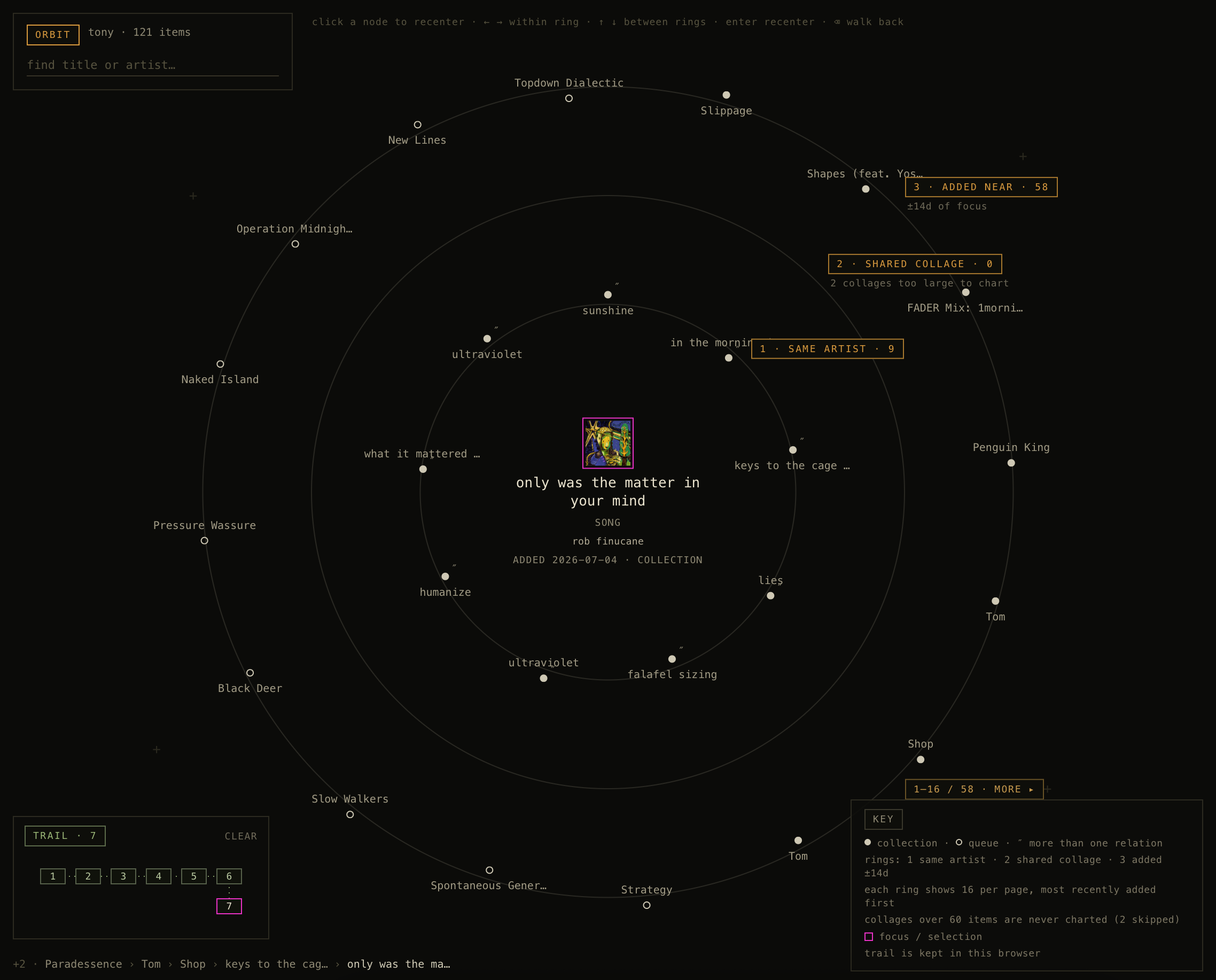
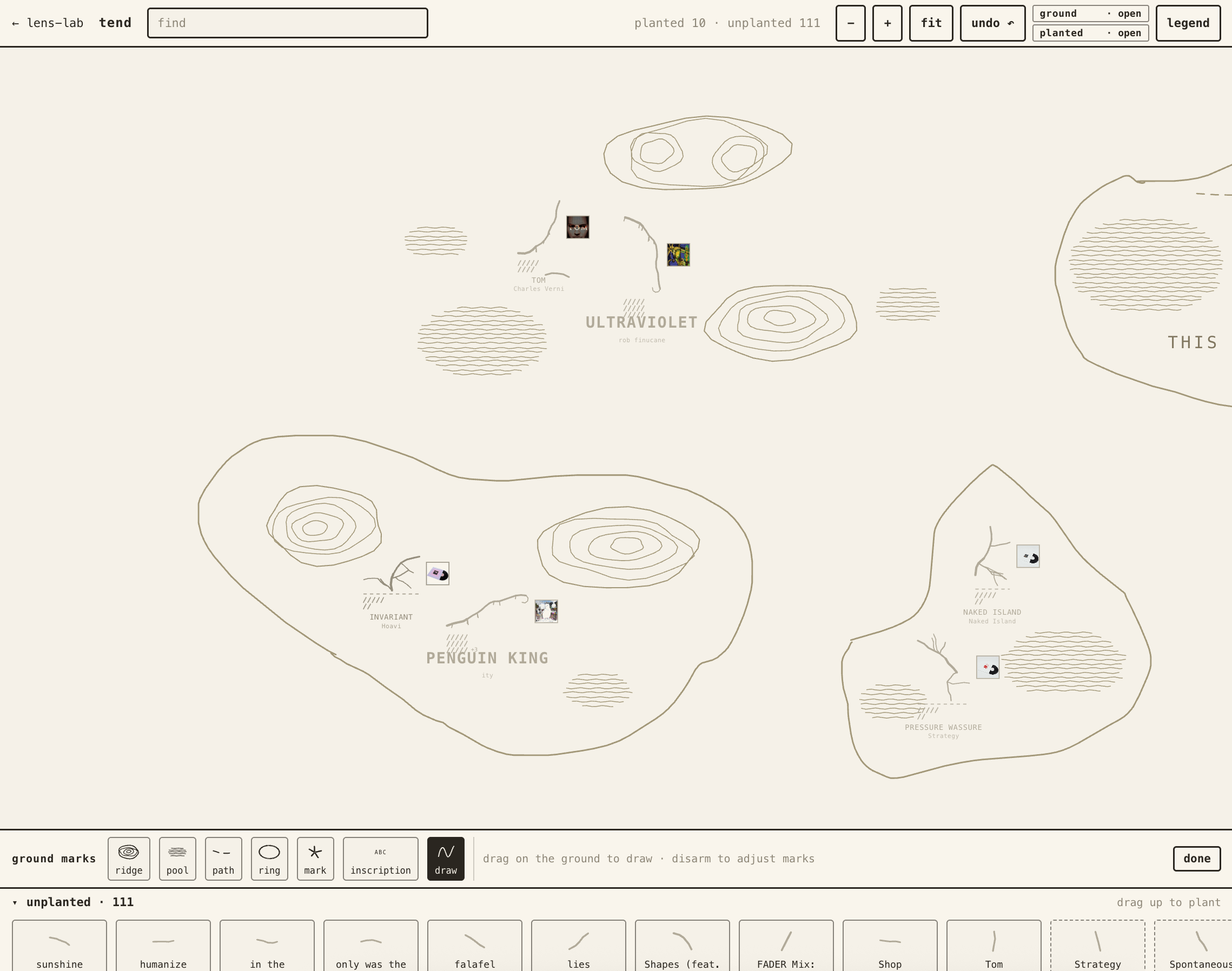
OK, so what is ctx?
Two things:
a place for your personal music library to live, outside of any platform, and take any form you can imagine
aspirationally, a collective repository of music objects that might help balance the scales of power in the digital music ecosystem
Today it is already #1. You can begin using it now with a beta invitation. If you’d like one, please drop me a line, or leave a comment, my channels are all open.
In a new ontological sense.
DNS, the Unicode Consortium, the Linux kernel, Python, Project Gutenberg, Wikipedia, Archive.org, to name just a few.
✋
Nice work on this Tony. Excited to see how ctx develops